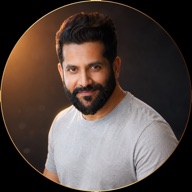
How does a doctor publish daily content without filming?
He has 374,000 followers, a full patient load, and no time to shoot. This is what we built, and what it actually produced.
Dr Madhu Sudan, an Ayurvedic wellness doctor with 374,000 Instagram followers, has published 95 reels this year without filming any of them. A system trained on his own face, voice and clinical thinking produces them, and he approves every script before it goes out. Those reels have drawn 1,809,743 views, and consultations now book while he sees patients.
- 95 reels published this year. The doctor filmed none of them.
- 1,809,743 views, averaging 19,305 per reel.
- Before this system, content had never produced a single lead for him.
- The AI clone is roughly ten percent of the work. Strategy, scripting and publishing are the other ninety.
- He approves every script. Nothing is published in his name that he has not read.
The problem was never marketing
Dr Madhu Sudan is an Ayurvedic wellness doctor with a real practice and a real patient load. He also had 374,000 people following him on Instagram. On paper that is an enviable position. In practice it produced nothing.
His own summary of the situation before we started is the sharpest line in this case study:
Content had never generated a single lead for him. Not one. Dr Madhu Sudan, on the years before this system
That is worth sitting with, because it contradicts what most experts are told. He was not invisible. He was not inconsistent in the way people mean when they scold you for inconsistency. He had an audience most consultants would envy. What he did not have was a system that turned attention into booked time, and he did not have the hours to build one while also seeing patients.
Every solution offered to him assumed the same thing: that he would spend more time in front of a camera. That was the one resource he had none of.
What we actually built
The instinct is to call this an AI avatar. That is the smallest part of it, and describing it that way is how people end up disappointed.
1. Capture how he thinks, not just how he looks
Cloning a face and a voice takes minutes and produces something hollow. The work that matters is capturing the way a specific expert reasons: which claims he refuses to make, how he explains digestion to a nervous patient, the words he actually uses rather than the words a copywriter would choose. For a doctor this is not a stylistic detail. Get it wrong and you have published medical content in his name that he would never have said.
2. A content strategy that maps to his practice
Pillars tied to what he treats and what he sells, so reach and revenue point the same direction. Content that performs but sells nothing is a hobby.
3. Scripts he approves before anything renders
He reads and approves every script. This is the non-negotiable part when the client is a credentialed professional whose licence is attached to his name.
4. Production and publishing, daily, without him
Rendering, editing, captioning, scheduling and posting run without his involvement.
5. The funnel underneath
Reach with nothing behind it is noise. Consultations and product sales run on rails that were built at the same time as the content, which is why the reels convert instead of merely performing.
What it produced
| 95 | Reels published, none of them filmed by him |
| 1.81M | Total views across those reels (1,809,743) |
| 19.3k | Average views per reel (19,305) |
| 365k | Views on the strongest single reel, with 5,652 likes — see it |
The average matters more than the peak. One reel at 365,000 views is a story you could tell about luck. Eighty-nine reels holding a steady average is a machine, and that distinction is the entire point. Most experts no longer need convincing that AI content is possible. They need convincing that somebody runs the whole line, every day, at a standard that does not embarrass them.
The reels were never the whole job
Content that reaches people who then have nowhere to go is an expensive hobby. So the same engagement built the machine underneath it. All of this is live and you can open any of it:
| Consult | The consultation funnel. Where a reel viewer becomes a booked appointment. |
| Assess | A self-assessment that qualifies people before they ever reach his calendar. |
| Modak | The product funnel. Reach turning into supplement sales without him selling. |
| Blogs | The search and AI layer, so the content compounds instead of evaporating. |
| Routine | A patient-facing routine builder that keeps people engaged between visits. |
| Pulse | His private dashboard. One window onto everything the system is doing for him. Not linked here, it is his. |
Six properties, built alongside the content, none of which he maintains. This is the part that separates a content service from a system. The reels create attention; these decide what happens to it.
The part most people get wrong
The clone is about ten percent of this. The other ninety percent is strategy, scripting, production, publishing and the funnel.
That ratio is the honest answer to the question everyone asks first, which is which tool we use. The tool is not the hard part and it is not where the results come from. Anyone selling you the ten percent is selling a tool and calling it an outcome.
It is also why the do-it-yourself version usually stalls. Cloning yourself is a weekend. Publishing every single day for a year, at a quality that builds trust rather than eroding it, is an operation.
Who this works for, and who it does not
It works when someone has genuine expertise, a real offer, and no time. The constraint being removed is the expert's physical presence, not their judgment. Their face, their voice, their standards and their approval all stay.
It does not work when there is no offer behind it. Content that reaches people who cannot buy anything is an expensive hobby, and no amount of automation fixes that. If a business has a marketing problem rather than a systems problem, this is the wrong tool.
Common questions
Can a doctor publish content without filming it?
Yes. Dr Madhu Sudan has published 95 reels this year without filming any of them. A system trained on his own face, voice and clinical thinking produces them, and he approves every script before it goes out.
Does AI-generated content still sound like the expert?
It depends entirely on what the system is trained on. Cloning a face and a voice takes a few minutes and produces something hollow. The part that makes it sound like the expert is capturing how they think, which claims they refuse to make, and the words they actually use with patients.
How much of this is the AI clone?
About ten percent. The clone renders the face and voice. The other ninety percent is content strategy, scripting, production, publishing and the funnel behind it. Anyone selling only the clone is selling a tool, not an outcome.
How long does the expert spend on it each week?
Approval time only. The expert reads and approves scripts. They do not film, edit, schedule or publish. Nothing goes out in their name that they have not read.
Find out where your business still needs you in the room.
Thirty minutes. We map where you are still the bottleneck, and I tell you honestly whether this is worth building for you. If it is not, I will say so.
Show me what this looks like for my business